Class 8 · Geography · Chapter 4
Industrialisation and International Trade
From Secondary Geography for Pakistan by Dean Smart (Oxford University Press, First Edition)
See this book on oup.com.pk (the publisher's page, opens in a new tab)
Find out how Pakistan earns its living: what an economy is, how countries trade, the sectors that make up our economy, how industry is changing our towns and cities, and how science, technology and trade agreements can help Pakistan grow. Each part explains the chapter in simple words, quotes the book, points out where the book needs correcting, and ends with quick questions to check your understanding.
The big picture
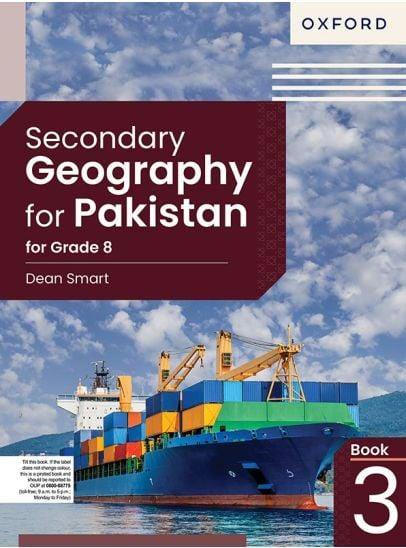
The chapter opens with a photo of a huge container port, with cranes and stacks of shipping containers. Almost everything we buy has travelled through a port like this. This chapter is about how countries make things, sell them to each other and grow richer.
In this chapter
- 4.1 What an economy is, how countries trade, the four sectors of the economy and Pakistan's main industries.
- 4.2 How industry has changed Pakistan, from cottage crafts to textile mills, and why people move to cities.
- 4.3 How science and technology help industries grow.
- 4.4 Why countries set trade rules, Pakistan's trade with China, and how Pakistan can compete.
What is an economy?
Economic geographers study how people use land and natural resources to make, move and sell things, and how that activity affects places, people and the planet.
An economy is made of
- Production: making goods.
- Distribution: transporting them.
- Trade and commerce: buying and selling.
- Consumption: using goods and services.
- The rules, institutions and taxes needed to run it all and pay for infrastructure.
A local economy refers to the economic activity that takes place within a specific geographic area, such as a city or region.
A national economy covers everything inside a country's borders, including how the government manages it through taxes. The global economy connects every country through trade, investment, supply chains and workers who move abroad. Countries depend on each other: each buys what others have in surplus.
- Economic stability
- An economy that grows steadily without sudden shocks. It attracts trade and investment and helps a country cope when world prices rise or fall.
- GDP
- Gross Domestic Product: the total value of all the goods and services a country produces in a year. GDP per capita divides it by the number of people.
The higher the global share of the wealth and of GDP, the more that can be invested in infrastructure.
The book's chart shows the United States with about a quarter of the world economy and China with about a seventh. All the countries outside the top 20 together make up only about a fifth.
Where should a business be built? The book draws a web of six locational factors that all depend on each other: land, raw materials, transport, power, money and workers. Governments can tip the balance with incentives that encourage businesses, or regulations that limit them.
- Entrepreneur
- A person who starts a business with new ideas, products or services, taking a risk to do so.
- Investor
- Someone who puts money into a business in return for a share of its profits, and its risks.
Trade, sectors and industries
Trade refers to the exchange of goods and services between countries.
Exports are things a country makes and sells abroad; they bring money in and create jobs. Imports are things it buys from other countries, usually because it cannot make them, or not enough of them, at home.
Pakistan's top trade goods
- Exports: textiles and clothing, rice (especially basmati), leather goods, and sports goods such as footballs and cricket balls.
- Imports: petroleum (oil and gas), machinery, chemicals such as fertilisers, and food such as wheat, sugar and edible oil.
Pakistan’s imports outweigh its exports, which upsets its balance of trade.
- Balance of trade
- The difference between what a country earns from exports and what it spends on imports. When imports are bigger, the country has a trade deficit.
To earn more, Pakistan can sell processed goods (cloth rather than raw cotton), improve quality with technology, find products in high demand abroad and make itself more attractive to investors. To spend less, it can make more at home, develop renewable energy instead of importing fuel, and put tariffs or quotas on imports.
The sectors of the economy
- Primary: taking raw materials from nature, such as farming, fishing, forestry, mining and drilling for oil and gas.
- Secondary: making raw materials into new products in factories, from tins to trains.
- Tertiary: providing services, such as shops, transport, hotels, health care, teaching and the police.
- Quaternary: highly specialised knowledge work, such as research scientists, lawyers and university professors.
The book follows wheat through the sectors: a farmer grows it (primary), a mill makes flour and a bakery makes bread (secondary), and shops sell the bread to customers (tertiary).
Tourism and the leisure industries are in this group, and are growing in importance as people have more wealth and leisure than in the past and want to spend time relaxing.
Pakistan's main industrial products include textiles, cement, steel, fertiliser, sugar, vehicles, medicines, processed food and sports goods. Its services sector, including information technology, telecommunications and banking, is growing too.
Practise this section: 10 quiz questions →Industrialisation in Pakistan
In 1947 Pakistan's economy was mostly farming, with small workshops in the towns. Since then it has changed enormously. After the pandemic lockdowns, the economy grew strongly again: about 6% in 2021–22, with industry growing fastest.
- Industrialisation
- The change from a society based on farming to one based on machines, factories and large-scale production.
- Urbanisation
- The growth of towns and cities as more people come to live in them.
Industrialisation, urbanisation, and immigration are all interconnected processes that have shaped the modern world.
Factories create jobs in cities, so people from low-paid work in the countryside move there for better pay and a better life. Geographers call this urban drift. As cities grow, they attract still more people, and some people move abroad for work too.
The same correction applies to this box: people moving to cities inside their own country are internal migrants, not immigrants.
Fast-growing cities face crowding and pressure on water, housing, transport and other services.
Before big factories, many goods were made at home. Pakistan's cottage industries include carpet weaving, embroidery, jute weaving, woollen knitwear, ceramics, jewellery, knives and cricket bats.
Cottage industries in Pakistan are significant because they employ women, especially those living in rural areas who are otherwise culturally discouraged from leaving their homes.
- Cottage industry
- Small-scale, traditional manufacturing done by families in their own homes.
- Economies of scale
- The fall in the cost of making each item when a factory makes many of them, because costs like machines and buildings are shared across more items.
Because factories enjoy economies of scale, home workshops find it harder and harder to compete on price, although there will always be buyers for skilled, one-off handmade items.
It now contributes to more than 60% of the country’s total exports.
That is Pakistan's textile industry, its premier industry and a huge employer. Its spinning mills buy enormous amounts of cotton, the country's largest cash crop, so farms and factories depend on each other.
The four stages of textile production
- 1. Spinning: raw cotton is cleaned and spun into yarn.
- 2. Weaving: yarn is woven or knitted into fabric.
- 3. Wet processing: the fabric is treated, dyed, printed and finished.
- 4. Apparel manufacturing: cloth is cut, stitched and styled into clothes, then inspected, packed and shipped.
Science and technology in industry
Science and technology play a crucial role in industrial development.
New knowledge leads to new ideas for products and processes. Technology helps factories work faster and use energy and resources more carefully, which supports a stable economy. Science also improves workers' lives, through safer workplaces and better health care, and healthier workers are more productive.
Six ways science and technology help industry grow
- Research and development (R&D): creating new and better technologies, products and processes.
- A skilled workforce: education and training in science and technology.
- Technology transfer: bringing advanced technology in from other countries.
- Innovation: incentives for entrepreneurs, start-ups and small businesses with new ideas.
- Infrastructure: modern internet, power, transport and logistics.
- Government support: funding R&D, tax incentives and supportive policies.
- Research and development
- R&D: work to discover new knowledge and turn it into new or improved products and processes.
- Technology transfer
- Bringing technology and know-how developed in one country into another, often through foreign companies or partnerships.
Pakistan's space agency, SUPARCO, is an example. It researches space science and technology for peaceful uses, such as satellites for communications and weather.
Practise this section: 10 quiz questions →Trade rules, China and competing
Trade regulations are essential for a country’s economic development since they protect the domestic industries from foreign competition, allowing them to develop.
- Tariff
- A tax on imported goods, which makes them dearer so that local products can compete.
- Quota
- A limit on how much of a product can be imported.
- Embargo
- A ban on trading with a particular country or in a particular product.
Barriers like these limit imports and encourage exports, which helps a country's balance of trade. Governments also require licences and shipping rules so that trade runs smoothly.
Trade between Pakistan and China benefits both countries. China is a huge market that imports a lot, and Chinese investors have been putting money into Pakistani businesses. Through the China-Pakistan Economic Corridor (CPEC), China gains a route to the sea at Gwadar Port, while Pakistan gains help building roads, power stations and other key infrastructure.
- Bilateral trade
- Trade between two countries, where each buys from and sells to the other.
Pakistan's main trade partners are the United States, China, the United Arab Emirates, Saudi Arabia and the United Kingdom.
By exporting to a variety of countries, Pakistan can reduce its dependence on any one market and minimise the impact of economic downturns in any one country.
Other ways Pakistan can compete
- Find niche products: things in high demand that competitors do not supply well.
- Improve transport, energy and communications so business is easier and cheaper.
- Support entrepreneurs and small and medium-sized businesses.
- Make the business climate friendlier: less corruption and red tape.
- Invest in education and training for a skilled workforce.
- Build strong diplomatic relations with other countries.
Looking back
Pakistan has moved from a farming economy towards an industrial one, with textiles leading the way. But it still imports more than it exports. Adding value to its products, using science and technology, supporting small businesses and trading wisely with many partners can help Pakistan grow and raise living standards.
Remember
- GDP is the value of everything a country produces in a year.
- Exports bring money in; imports send it out. Pakistan has a trade deficit.
- Primary industries take resources, secondary make products, tertiary provide services and quaternary provide knowledge.
- Moving to a city within Pakistan is internal migration; immigration means moving to another country.
- Textiles make up more than half of Pakistan's exports.
Key terms flashcards
Read the term, say what it means, then flip the card to check. You know 0 of 15 terms.
Card 1 of 15Tap the card to see the meaning
Ready to test yourself?
Practise with 64 questions on this chapter, with feedback after each answer, or try an exam-style quiz.
Take the Chapter 4 quiz